 The Organism
New Harmony High
Before the data, before the platform — there was us.
We are not a building, and we are not a statistic on a spreadsheet. An organization is the sum total of its employees and the community members it is meant to serve. New Harmony High is the collective experience of everyone who contributed their voice to this living ecosystem.
The Human Relations Foundation
Organizations as Living Ecosystems
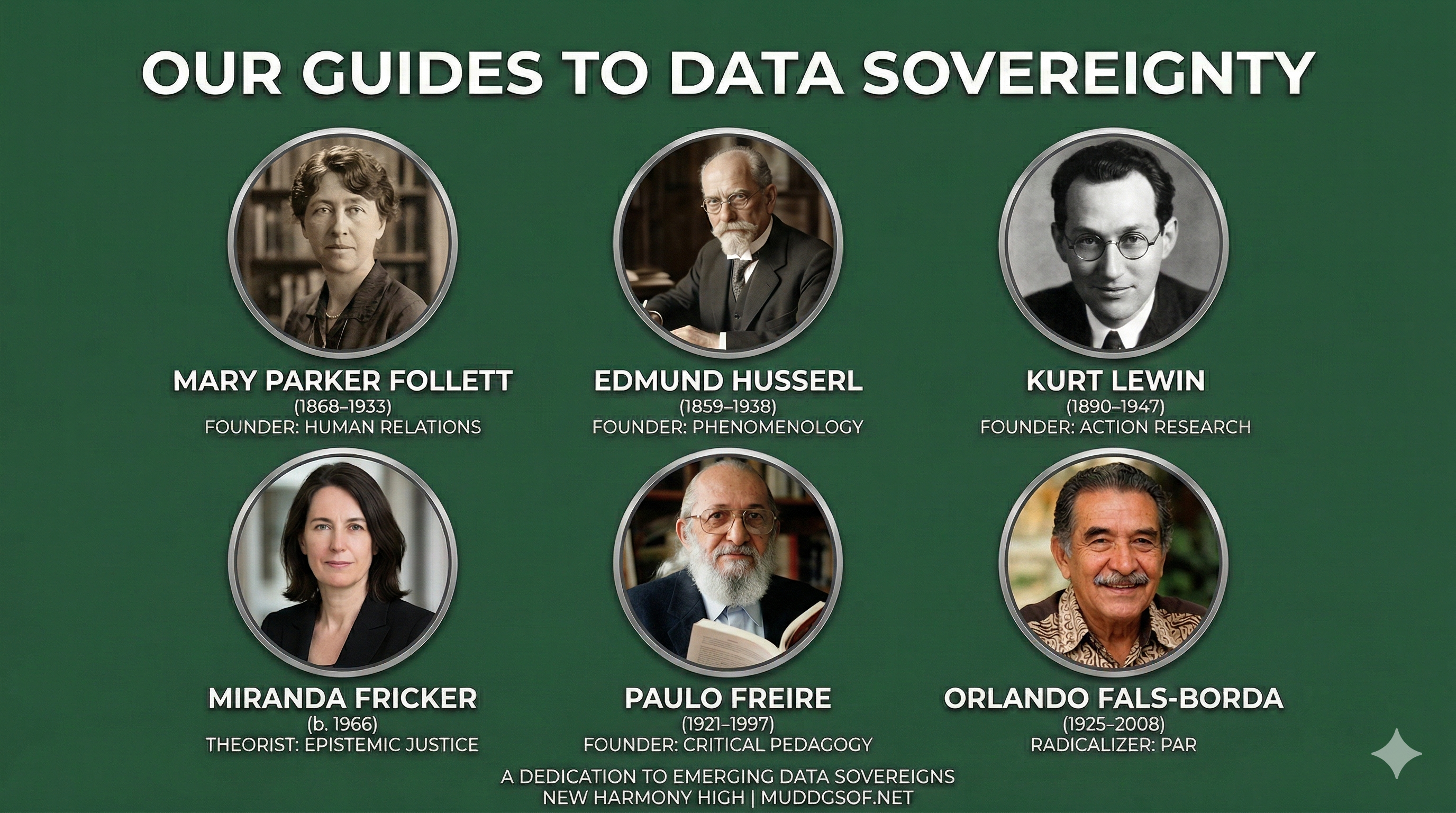
- Theoretical Anchor: Mary Parker Follett (1868–1933) — a radical social worker and the "Mother of Modern Management," ignored for decades because she believed workers, not bosses, held the true keys to productivity.
- The Logic: Follett argued that true power is "power-with," not "power-over." The most efficient way to run an organization is to tap into the expertise of those on the front lines.
- The Cellular Principle: To understand the health of a community, you don't ask an outside auditor — you ask the "cells," the people who live the work every day.
The Phenomenological Starting Point
Examining our Lifeworlds
We began with an examination of our Lifeworlds (Lebenswelt) — the world as we actually experience it, before "experts" tell us what it is.
- Husserl · Descriptive: We "returned to the things themselves," describing our experiences exactly as they appeared, without outside judgment.
- Heidegger · Interpretive: We looked for the meaning behind our stories — recognizing that our neighborhood and school are full of unique personal significance.
- Schütz · Social: We mapped our shared reality. By involving 50+ students, we turned individual perspectives into a collective map of our world.
Epistemic Justice
Crowdsourcing Community Knowledge
- The Source: Miranda Fricker (2007) — a philosopher at NYU who defines Testimonial Injustice as the act of dismissing a community's knowledge as "unreliable" because of who they are: students, youth, locals.
- The Logic: By keeping 170 items to ensure every student was represented, we rejected "statistical parsimony" (oversimplification) in favor of Human Fidelity. Everyone's voice was a necessary variable.
- The Authority: In our system, the student is the primary authority of their own experience.
Endogenous Research vs. Data Extraction
From "Data Subjects" to Data Authors
- Endogenous Development Theory: Championed by sociologists like Raymond Boudon — true growth must be generated from internal assets, not imported from outside.
- The Extractive Model: Most researchers are like a mining company. They take your "raw material" (your answers), process it elsewhere, and keep the profit (the degree, the policy power).
- The Endogenous Shift: We grow from within. We own the questions, the platform, and the refinery. We are the researchers, the subjects, and the owners of the results.
The Pillars of Participatory Action Research
Research for the People, by the People
Participatory Action Research (PAR) is the tradition that says research should be done with communities, not on them. Three thinkers built its foundation:
- Kurt Lewin (1944): The founder. He argued that if you want to understand a system, you must try to change it. He coined "Action Research" to move science out of the lab and into the community.
- Paulo Freire (1968): The teacher. In Pedagogy of the Oppressed, he argued that the act of learning about your own reality is the first step toward freedom. He rejected "banking" education in favor of active inquiry.
- Orlando Fals-Borda (1970s): The radicalizer. He merged research and social justice into Participatory Action Research, arguing that "common people" possess a "popular science" more valid than elite university science.
Building the Cognitive Infrastructure
Owning the Means of Production
We didn't use a corporate cloud or a third-party survey tool. We built the Muggsof Platform.
- The Chops: Cloudflare Tunnels, local-first AI, and custom SQL databases — housing our truth independently.
- The Logic: True Data Sovereignty requires owning the infrastructure. If you don't own the server, you don't own the narrative.
- The Engine: You have built the machine that powers the story.
Methodological Agency
Organizing as Research
- The Framework: Applied PAR — Participatory Action Research in practice.
- The Reality: We managed a school-wide, multi-session data collection event. We used real-world organizing tactics — incentives, homeroom competitions, collective effort — to ensure a representative sample.
- The Logic: In social work and organizing, the process of coming together is as important as the data itself. Participation is not just "filling out a form"; it is an act of community building and shared agency.
Defining Our Own Metrics
The Authority of the Local
Outside institutions use their own metrics to define us. By creating our own instrument, we reclaimed the authority to set the standards for what "success" and "health" look like at New Harmony High.
From objects of someone else's study, to authorities of our own reality.
From Data Points to Stories
"Us Learning About Us"
- The Chops: Statistical analysis, pattern recognition, and Narrative Inquiry.
- The Logic: Data is the quantitative shadow of our qualitative lives. By learning to read that shadow, you aren't just doing math — you are performing an act of Narrative Reclamation.
- The Right: You are taking back the right to tell the story of your own life.
The Social Work Legacy
Data as Community Organizing
- The Inspiration: The Settlement House Movement and social workers who knew that "charity" isn't enough — you need structural change.
- The Logic: Like a social worker entering a crisis, we didn't look for "perfect" conditions. We looked for Authentic Conditions. We looked for the red wheelbarrow, glazed with rain water, beside the white chickens.
- The Source: NASW Code of Ethics — Self-Determination and Social Justice. We moved from "saving" a community to "empowering" it through technical agency.
Scaling the Model
The Muggsof Infrastructure in the Real World
- Housing Advocacy: Endogenous surveys to track displacement and defend neighborhoods.
- Community Health (FQHCs / MHRs): Closing the feedback loop between practitioners and consumers to improve care from the bottom up.
- The Vision: Any organization that is its people can use this platform to own its data and its destiny.
Burgeoning Sovereignty
The Emergence of the Data Sovereign
You are leaving NHH with the emerging "chops" to build surveys and data systems for any organization. This is not the end of a project; it is the burgeoning of your professional power.
Carry the cells. Carry the cellular principle. Carry the legacy.
Sources & Further Reading
Organizational Sociology & Management
Follett, M. P. (1924). Creative Experience. New York: Longmans, Green and Co.
The foundation for "Power-with" and the idea that the "cells" of an organization hold the key to its health.
Morgan, G. (2006). Images of Organization. Sage Publications.
Specifically the chapter on "Organizations as Organisms," supporting the biological/living ecosystem view.
Phenomenology & The "Lifeworld"
Husserl, E. (1970). The Crisis of European Sciences and Transcendental Phenomenology. Northwestern University Press.
The origin of the "Lifeworld" (Lebenswelt) concept.
Schütz, A. (1967). The Phenomenology of the Social World. Northwestern University Press.
Grounds the idea of "Social Phenomenology" — how we experience a school or community as a shared reality.
Epistemic Justice & Data Sovereignty
Fricker, M. (2007). Epistemic Injustice: Power and the Ethics of Knowing. Oxford University Press.
The primary source for testimonial injustice — dismissing a community's voice as an ethical failure.
Carroll, S. R., et al. (2020). "The CARE Principles for Indigenous Data Governance." Data Science Journal.
The leading global framework for Data Sovereignty and Authority to Control.
Participatory Action Research (PAR)
Freire, P. (1970). Pedagogy of the Oppressed. Continuum.
Defines "Conscientization" and the rejection of the "banking model" of education.
Fals-Borda, O. (1987). "The Application of Participatory Action-Research in Latin America." International Sociology.
Grounds the "radicalization" of PAR and the concept of "Popular Science."
Cornwall, A., & Jewkes, R. (1995). "What is Participatory Research?" Social Science & Medicine.
Defends why participatory models are often more accurate than traditional ones.
Endogenous Development & Social Work
Boudon, R. (1991). "What Middle-Range Theories Are." Contemporary Sociology.
Provides the sociological backing for "Endogenous" development.
National Association of Social Workers (NASW). (2021). Code of Ethics of the National Association of Social Workers.
Supports the values of "Social Justice," "Dignity and Worth of the Person," and "Self-Determination."
Narrative & Counter-Storytelling
Solórzano, D. G., & Yosso, T. J. (2002). "Critical Race Methodology: Counter-Storytelling as an Analytical Framework for Education Research." Qualitative Inquiry.
Argues that marginalized communities must tell their own stories to counter the dominant narratives.
Test Your Sovereignty
Ten Questions on the Foundations
Log in to complete this graded quiz.
Log InChoose the best answer for each item. After you submit, you'll see your score and explanations.